

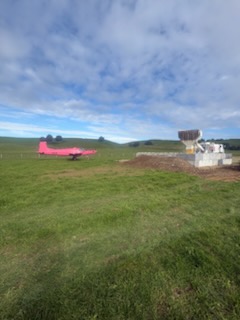
When Tim Mouat looked at his existing fertiliser bin, the issue was practical rather than dramatic. The timber sides on the old bin needed replacing, but the concrete pad underneath was still there and still useful. The job was not about starting again. It was about finding a way to work with what was already on site and end up with something that would last.
That is where Interbloc came into the picture. Instead of a full rebuild, the project became a careful upgrade: reuse the existing pad, simplify the build, and create a bin that would do the job now while still leaving options open for the future.
Starting with What Was Already There
The challenge was straightforward. As Tim explained, “We needed to replace our wooden sides on our old fert bin and use existing concrete pad.”
That one line captures the shape of the project. The need was not for something flashy or overbuilt. It was for a solution that made sense on a working site: practical, durable, and able to fit the conditions already in place.
Using the existing concrete pad mattered. It meant avoiding major construction and making better use of what was already there. In a project like this, that is often where the real value sits.
Why Interbloc Made Sense
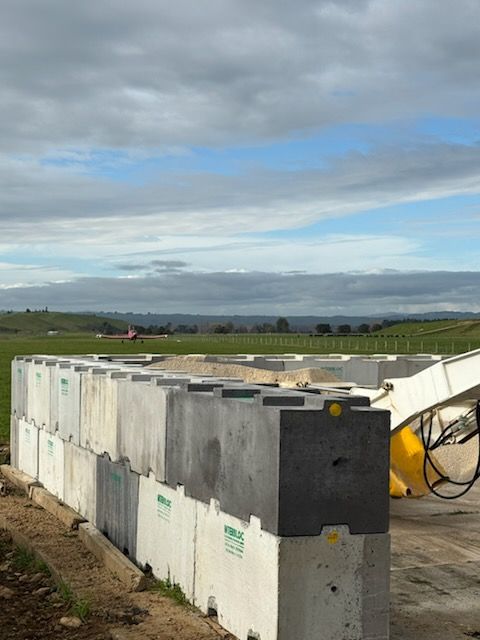
Tim’s reason for choosing Envirocon was simple: “Uniformed blocks that fitted together nicely.”
There is a lot in that observation. For a project like this, neat fit and consistency are not small details. They affect how easily the structure goes together, how the finished bin looks, and how confident the customer can feel about the result.
Interbloc suited the job because it worked with the site rather than against it. The modular format made it possible to adapt the structure to the existing pad, while the uniform block system helped keep the build straightforward.
Seeing the End Result Before the Build Started
One of the most useful parts of the project was the design process. Tim put it plainly: “Been able to have a visual design helped with knowing what the end product would look like.”
That visual step helped turn an idea into something more concrete. Instead of trying to picture the finished bin from measurements and conversation alone, Tim could see where the project was heading before installation began.
Just as important was the support around that process. Tim described the experience this way: “Envirocon were easier to get hold of and available on phone when needed throughout the design process.”
That kind of accessibility matters. On projects like this, progress often depends on being able to ask a question, check a detail, and keep moving.
A Straightforward Installation
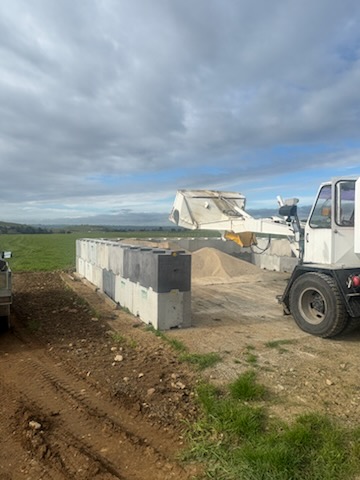
When it came time to install the bin, the process was uncomplicated. Tim’s description was direct: “Installation was simple and a quick one look at the design picture made it an easy process.”
That says a lot about how the system worked in practice. The design gave a clear reference point, and the modular block format kept the build manageable.
For a working farm or rural site, simplicity is part of the value. The easier a structure is to understand and assemble, the less disruption there is around the build itself.
What Mattered Most Once It Was Finished
After completion, the biggest benefit was not abstract. It was immediate and practical. In Tim’s words, “The major benifit for us was utilising our existing concrete pad without any major construction.”
That outcome brings the whole project back to its starting point. The goal was to upgrade the bin without unnecessary extra work, and that is exactly what happened.
Rather than demolishing and rebuilding from scratch, the project made better use of the site as it stood. The result was a more durable structure, built around an existing asset that still had value.
Built for Now, Flexible for Later
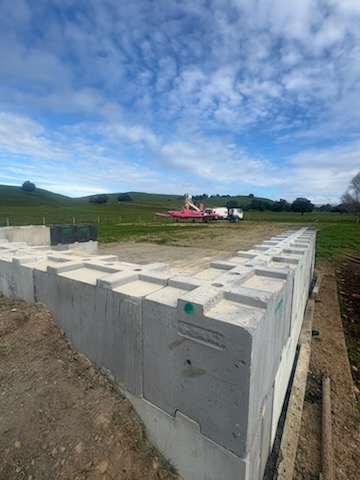
What stands out most in Tim’s feedback is not only how the bin works today, but how it could change later. As he put it: “The best part about interblock is if in the future we choose to add a sliding roof we can simply buy some more blocks and move about our existing block to suit.”
That long view is a big part of what makes modular systems useful. Needs change over time. A site that works one way today may need to work differently later. A structure that can be adjusted, added to, or reworked offers a different kind of value than one that is fixed from day one.
In this case, the fertiliser bin solved the immediate need while still leaving room for the next version of the site.
A Positive Experience Overall
When Tim reflected on the experience as a whole, the comments were practical and unforced. He would recommend Envirocon to others because they were “easy to deal with in the design and logistics,” and because the “uniformed blocks look good.”
That combination is worth noting. The project was not only functional. It also ended with a finished result that looked tidy and well put together.
Conclusion
This was a modest project with a clear purpose: replace the old timber-sided bin, keep the existing pad, and create something more durable in its place. What makes it a good story is that the outcome stayed close to that original need.
The Interbloc system helped turn an ageing structure into something simpler, neater, and more adaptable. It worked with the existing site, made installation easier to manage, and left the door open for future changes such as a sliding roof.
For Tim, the value was practical from start to finish. The existing pad stayed in use. The installation was straightforward. And the finished bin did what it needed to do without making the project more complicated than it had to be.
HOW A HOME-GROWN EARTHWORKS PROJECT TURNED INTO A LESSON IN BUILDING SOMETHING BEAUTIFUL
Every good build starts with a problem. On a rural property in Matakana, the problem was three metres of raw, freshly cut earth, left behind after Peter Binsted carved out a platform for a new implement shed. It was solid ground, but bare and exposed, the kind of bank that keeps a landowner up at night wondering what happens in the next big downpour.
Peter wasn't a stranger to this kind of challenge. As a civil engineer, he'd seen plenty of retaining walls in his career, some that worked, and some that didn't. This time, the wall was his own, and he wanted two things from it: hold the ground, and look like it belonged there. A grey concrete slab wasn't going to cut it. He wanted something that looked like it had always been part of the landscape.
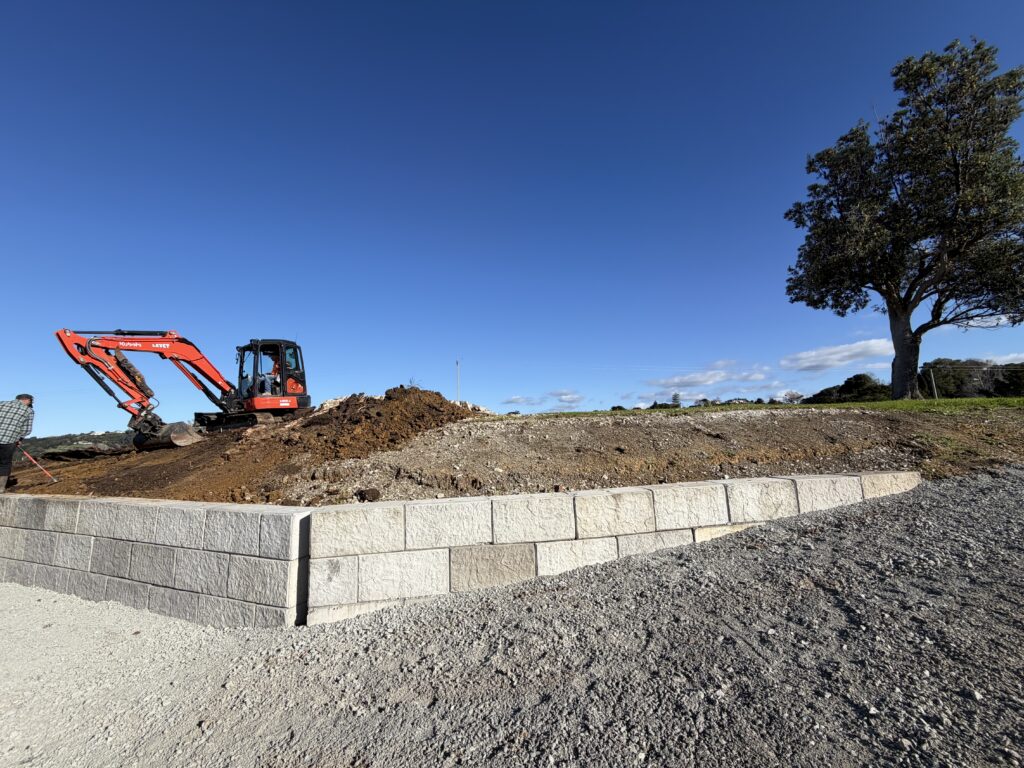
That search led him to Stonebloc, Envirocon's precast retaining wall system, built to look like hand-laid stone without the hand-laying. What won him over wasn't a sales pitch. It was the blocks themselves. Each one locks into the next like a giant, precisely engineered puzzle piece, so a wall goes up straight, true, and fast, without the fuss of mortar, string lines, or second-guessing. Add in the price and the finished look, and the choice made itself.
From the first phone call to the delivery truck pulling up the driveway, Peter found the whole experience with Envirocon refreshingly easy. Much of that came down to Ajisha Ann Chacko, the Envirocon® business development manager who worked with him from initial enquiry through to delivery. No chasing down answers, no waiting around wondering. Just a straightforward process that let Peter get on with the part he actually enjoyed: building.
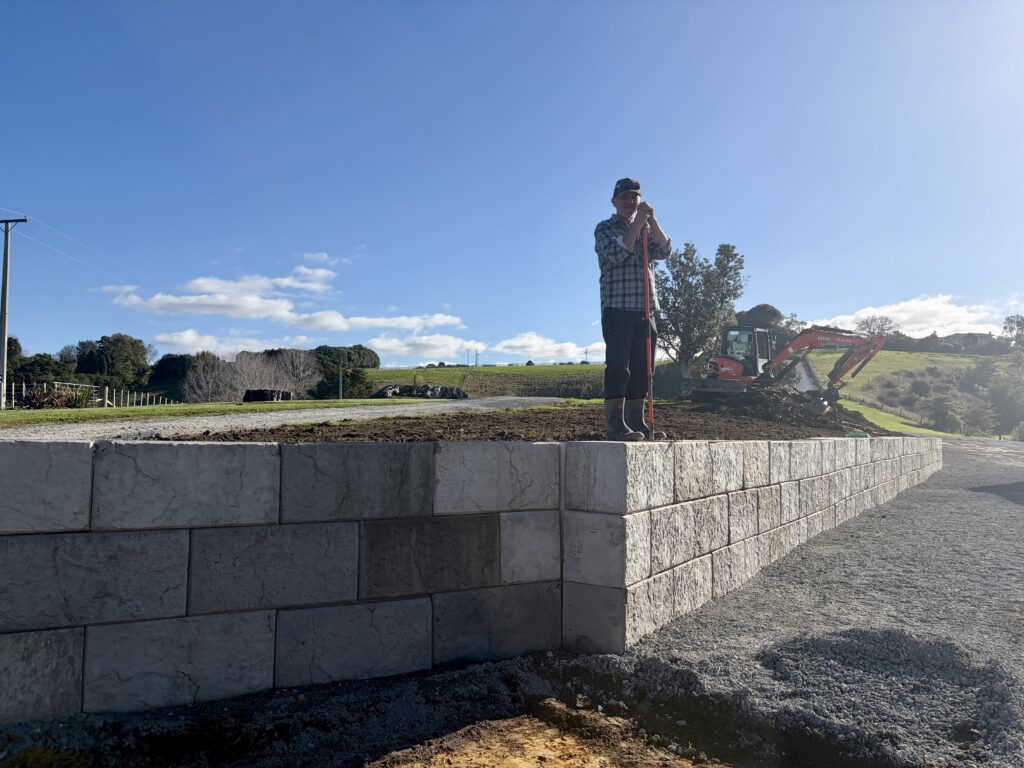
And building it, he did. As any good tradesperson will tell you, the real skill in a wall like this isn't in the tenth row, it's in the first. Get the very first course sitting level, straight, and square, and the rest of the wall practically builds itself. He leaned each block back a touch as he went, giving the wall a bit of a shoulder to lean into once the soil behind it was backfilled and doing its best to push forward. His advice to anyone tackling a similar job: keep it to three rows high, and let the wall do what it's good at.
The result speaks for itself. What was once a raw scar of cut earth is now a clean, textured stone wall that looks like it's been there for decades, not weeks. It holds the bank exactly as it should, and it turned a practical necessity into something Peter is genuinely proud to look at every day.
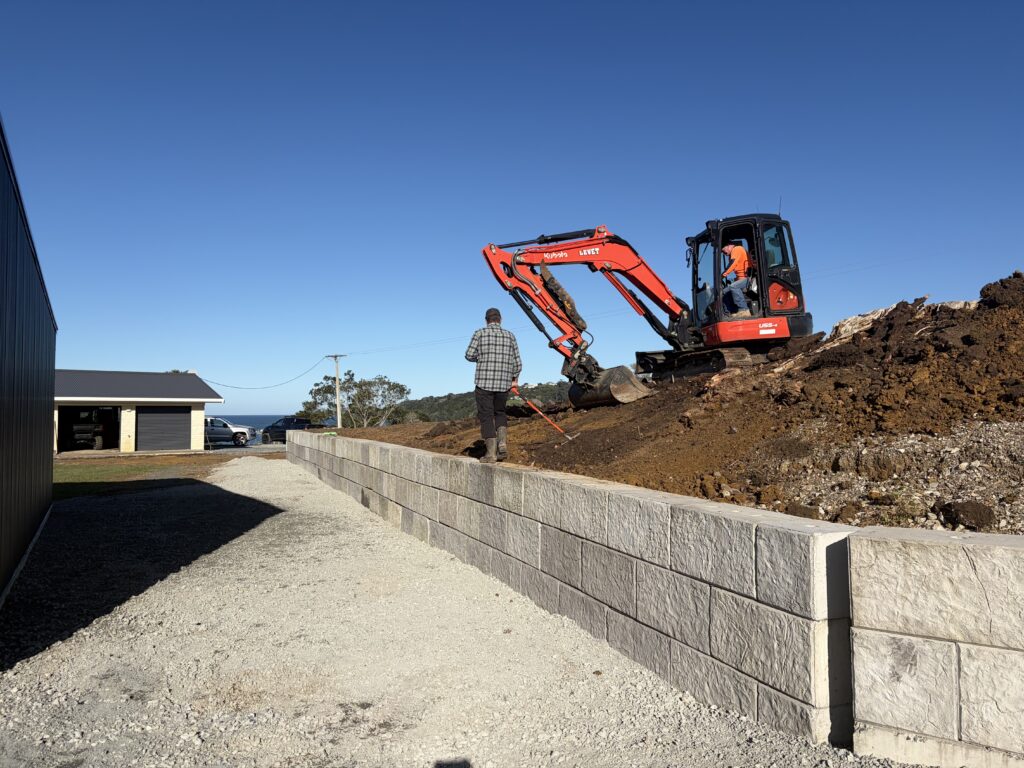
Ask him whether he'd recommend Stonebloc® to someone else facing the same problem, and there's no hesitation. Easy to build, easy on the budget, and easy on the eye, in his words, that's a combination hard to beat.
It's a small project in the scheme of things, one wall on one rural block. But it's exactly the kind of story Stonebloc was built for: turning an everyday earthworks problem into a lasting feature, block by interlocking block.
HOW ENVIROCON AND INTERBLOC DELIVERED A CENTURY-LONG SOLUTION FOR A CHRISTCHURCH CITY COUNCIL STORMWATER PROJECT
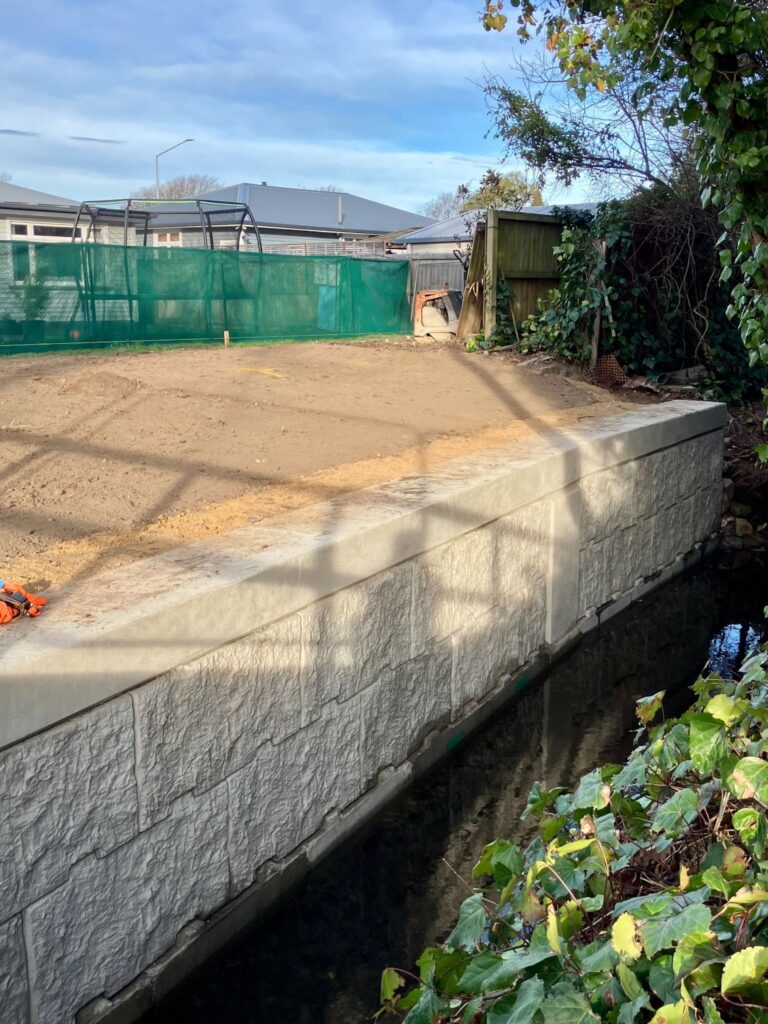
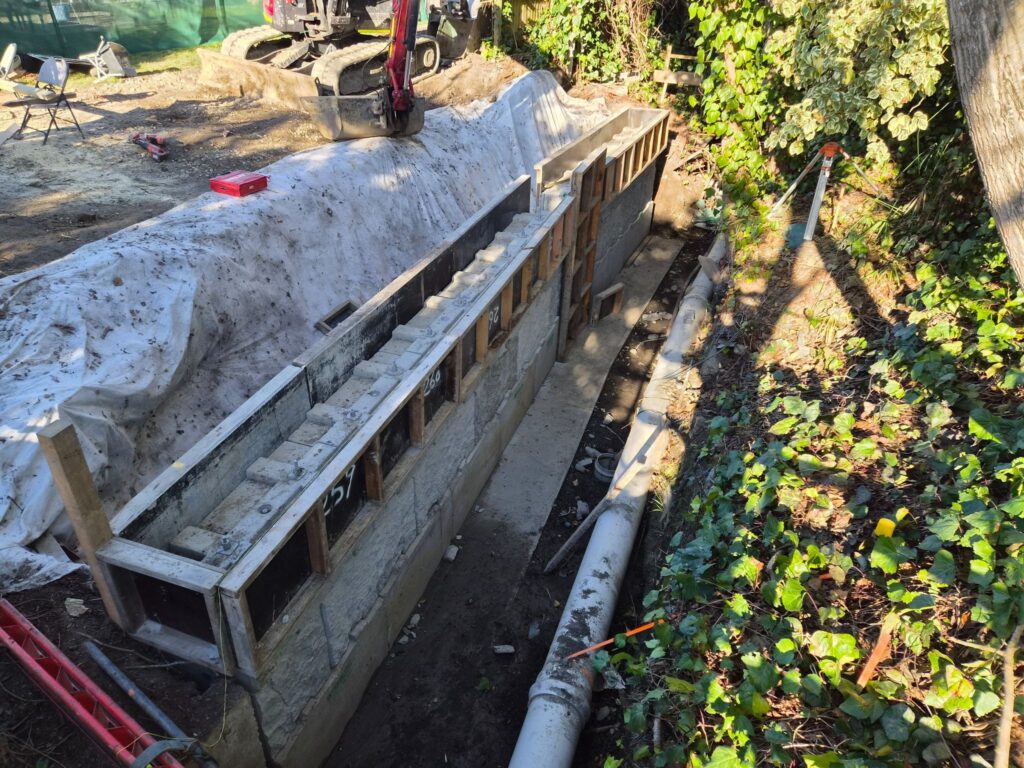
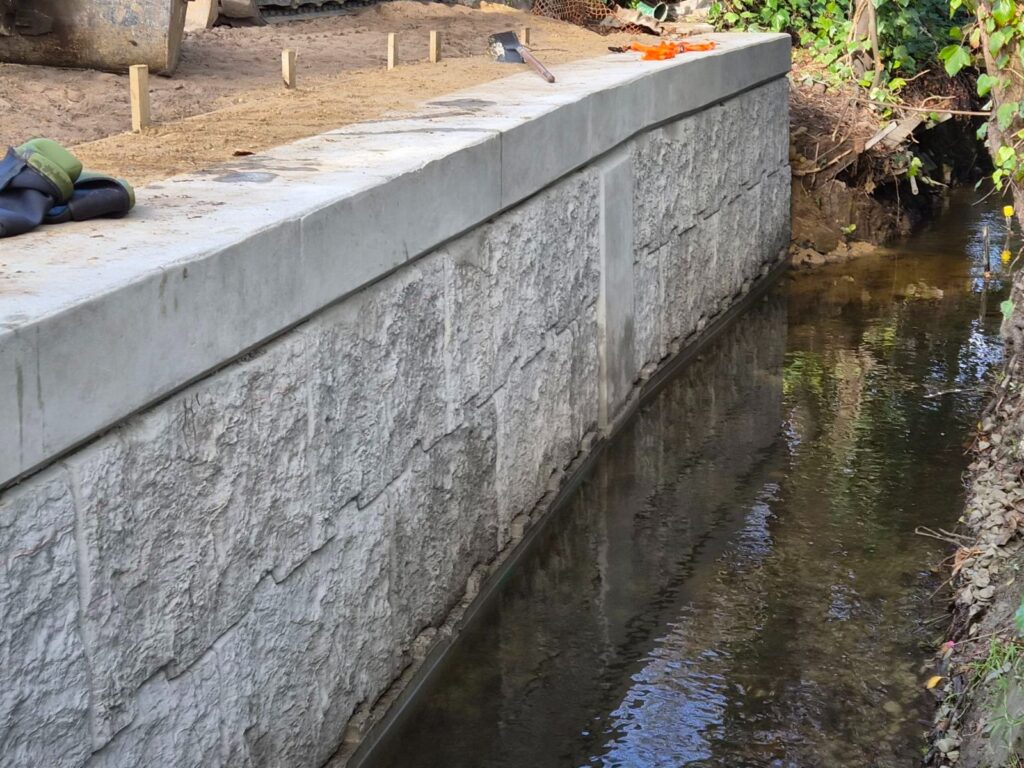
Open waterway channels are a part of Christchurch's stormwater network. When a section of waterway lining on Hills Road required renewal, the design called for single-sided bank stability along a Christchurch City Council open stormwater drain — and Interbloc® proved to be exactly the right fit.
THE CHALLENGE: SINGLE-SIDED, RESTRICTED ACCESS
Waterway lining in Christchurch typically follows a double-sided approach — timber walls on each bank, braced against each other with top and bottom struts. On this project, only one side of the channel required renewal. Without an opposing wall to brace against, a single-sided timber wall would have demanded piles at significant depth to remain stable.
That depth created a practical problem. The waterway runs through established residential land, with homes built near the bank. The heavy plant required to drive deep piles simply could not be accommodated within the available space. Interbloc was specified by Council as the solution: a gravity block wall that could be installed without tie-back sheets or deep piles, using equipment suited to constrained residential sites.
“Interbloc+ offered a 100-year design life”
- Council
WHY INTERBLOC+ CROATIA?
Interbloc’s 100-year design life means the infrastructure installed today serves the next generation without requiring contractors to re-enter private land ahead of schedule.
As a gravity wall system, Interbloc® relies on the mass of its 600mm-deep solid wet cast concrete blocks to resist lateral loads. In some soils and for specific wall heights, a mechanically stabilised earth configuration is not needed, which reduces the excavation behind the wall face. The system's unique interlocking shear key transfers forces between blocks and ensures stability.
Installation is rapid. Interbloc®'s self-aligning, Lego-style block design meaning this 20m section of wall could be built within two days — a meaningful advantage when working within the constraints of a live residential environment.
INTERBLOC CROATIA: STRENGTH WITH A REFINED FINISH
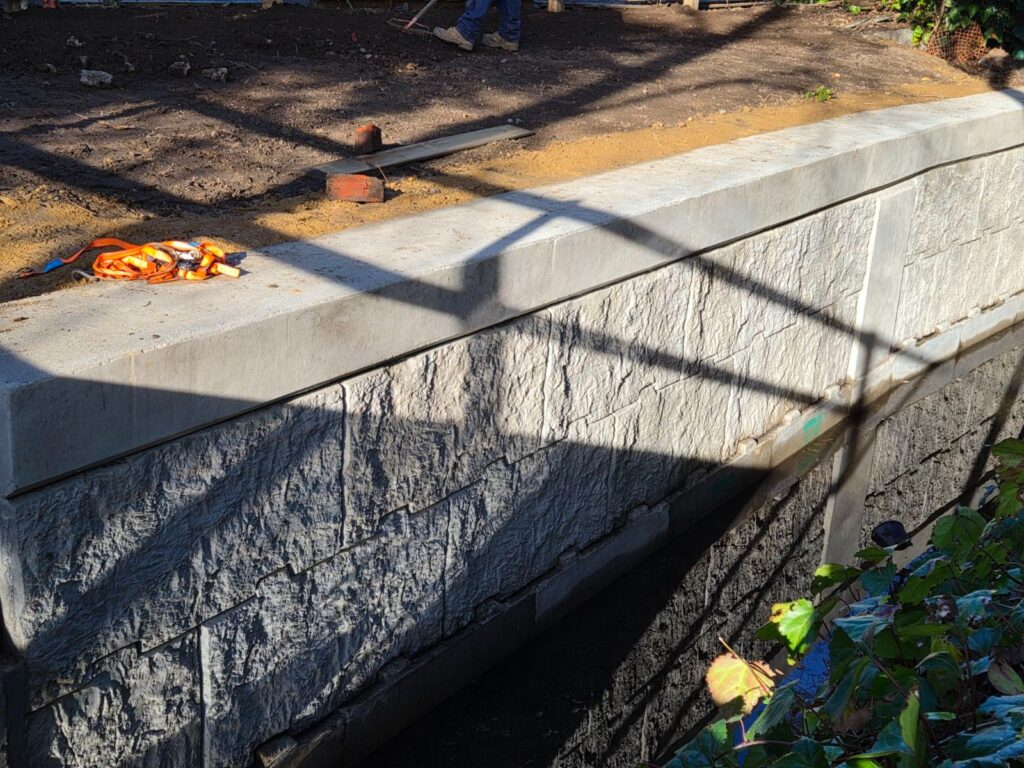
This project specified Interbloc® in the Croatia finish — a sleek, modern texture that brings visual refinement to infrastructure without compromising structural performance. Croatia is the right choice wherever a wall will be seen by the public: clean in appearance, durable over time, and consistent in finish across the full block range.
Croatia blocks are available across every Interbloc® block type — giving designers full flexibility to handle straight runs, curves, corners, and transitions within a single cohesive aesthetic. The Croatia finish retains its character for the full 100-year design life.
For waterway infrastructure that passes through public space — alongside bridges, paths, and roads — Croatia delivers a wall that will look as considered in decades as it does on day one.
A GROWING APPLICATION
Waterway lining is an emerging application for Interbloc®, and the Hills Road project has demonstrated the system's suitability for this context. Gravity block construction created a single sided waterway lining solution which is generally constructable in constrained urban environments, and the 100-year design life aligns directly with the long-term thinking that asset owners and councils increasingly demand from their infrastructure partners.
Envirocon® continues to work with engineers and contractors to develop configurations optimised for waterway conditions. As Christchurch's waterway network continues to be renewed and upgraded, Interbloc® Croatia is another option to maintain this important stormwater infrastructure.
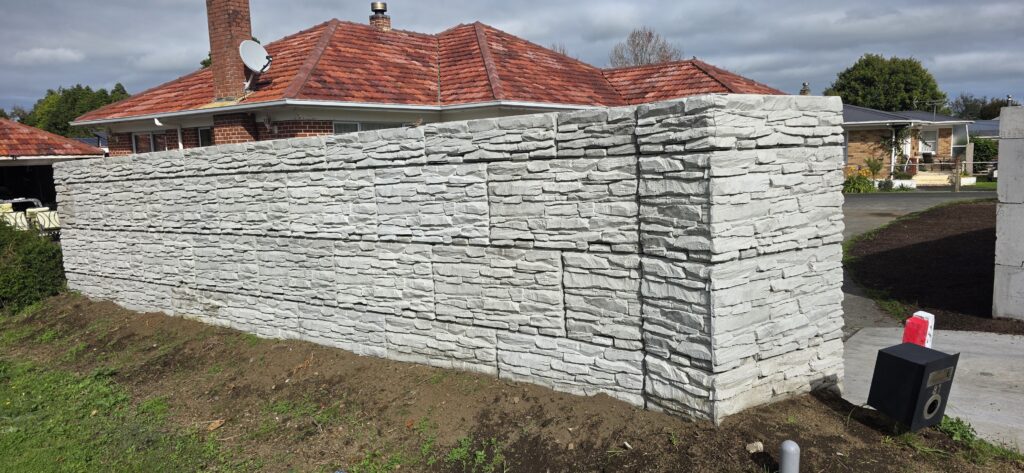
When Chris Wright decided to replace a crumbling brick boundary wall at his Waiuku home, he wasn’t looking for something ordinary. Positioned at the top of a T-intersection on the main road, the property demanded a solution that was substantial, safe, and — above all — visually compelling. What followed became one of Envirocon®’s most talked-about residential installations.
“I called in to the depot on the off chance — and immediately saw the Schist pattern blocks outside the office… DONE.”
THE CHALLENGE
The existing brick boundary wall at 81 Kitchener Road had become structurally unsafe — cracked and unstable from years of exposure and minor traffic incidents at this busy intersection. Chris needed a replacement that could handle the real-world demands of a high-traffic location while delivering something architecturally interesting.
His brief was clear: no plain wooden fences, no standard cinder block. The wall needed to be solid enough to withstand potential vehicle impact, tall enough to block headlight glare into the lounge, and distinctive enough to stand out in a streetscape full of painted-black timber paling.
THE SOLUTION: INTERBLOC+
Chris had previously noticed Interbloc+ being used in commercial retaining and storage applications, and appreciated the precision of the interlocking block system. A visit to the Envirocon® depot introduced him to the Schist texture — a rugged, layered-stone finish that offered the visual character he was after, without compromising the structural integrity he required.
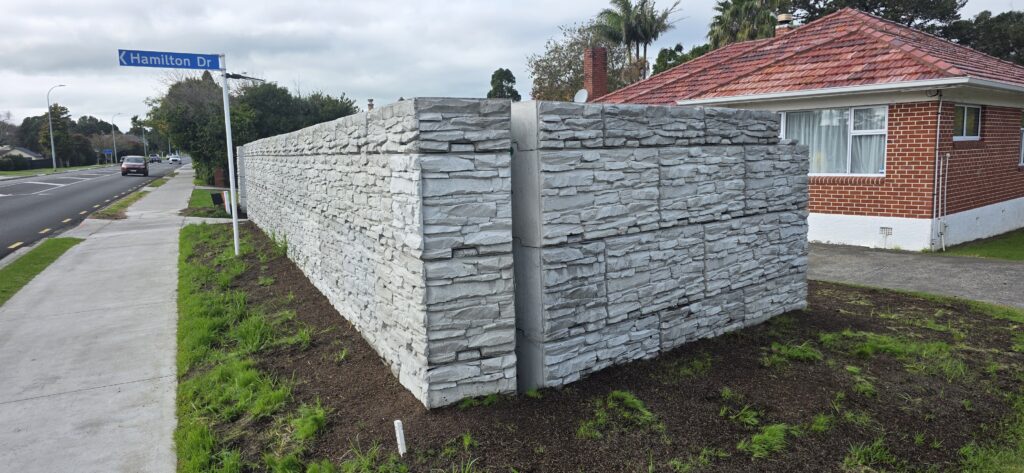
At the time, the Schist blocks needed to be brought into production. Envirocon® went further: they developed custom corner blocks carrying the Schist pattern onto the side walls, ensuring the textured face wrapped cleanly around the ends rather than terminating in a blank concrete surface. The additional production lead time was, in Chris’s words, “worth it.”
THE BUILD
Once the extensive foundation was in place, construction of the wall itself moved quickly — a direct demonstration of Interbloc®’s self-locating, Lego-style assembly. Rather than a standard concrete base, the foundation used varying sizes of steel to maximise grip beneath the blocks. The crew required only a grinder to remove the occasional burr. Speed, however, was not the most memorable aspect of the build.
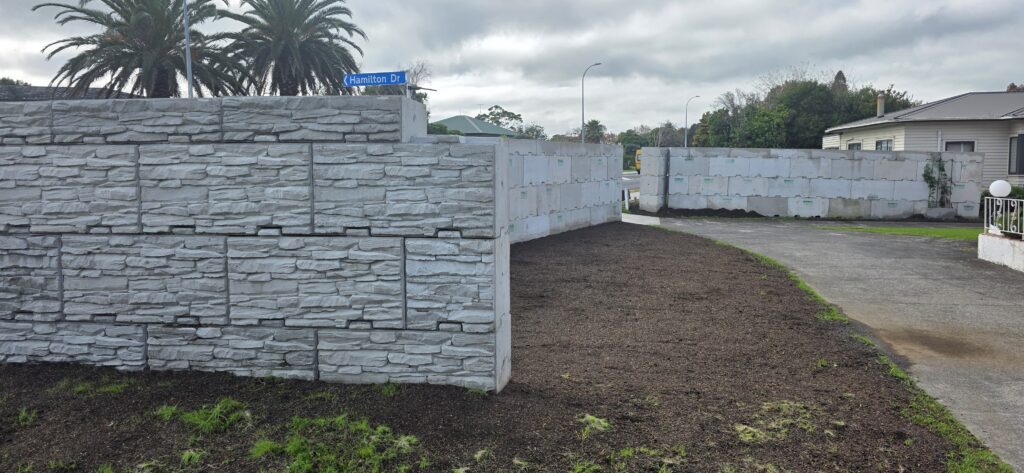
The site became an attraction. Cars stopped at the intersection; drivers leaned out windows asking questions. Pedestrians parked up and walked back to enquire about the product, the supplier, and the cost. The installation drew enough public attention that it began slowing the crew down. Waiuku had not seen anything quite like it.
“Are you building a Castle?” — It was the talk of the town.
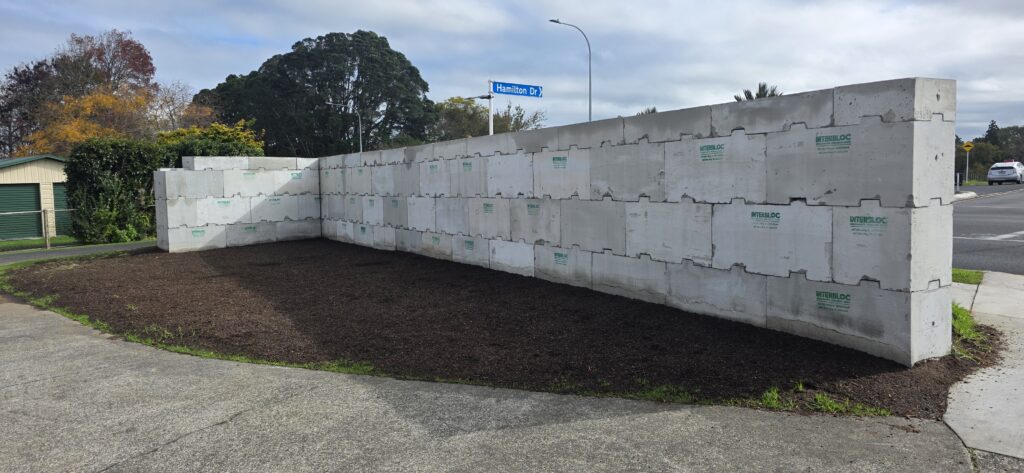
One practical consideration did emerge: the Interbloc+ system is optimised for right-angle construction, and the section at 81 Kitchener is not square. The solution was to construct four separate walls, with plantings planned to conceal the gaps at the joins — a landscaping solution that will ultimately add further softening to the overall composition.
OUTCOMES
The completed wall has delivered results well beyond its original brief:
- Road noise reduced by approximately 50% — the front of the property, previously too loud for conversation, is now a functional outdoor living space complete with table, chairs, and lighting.
- Headlight intrusion into the lounge has been fully eliminated.
- The street-facing Schist texture has become a local landmark, prompting widespread community interest and enquiries about the product.
- Flowering creepers are being established on climbing wires to further soften the wall and integrate it into the garden setting.
“It turns out there is more than one use for oversized blocks.”
OVERVIEW
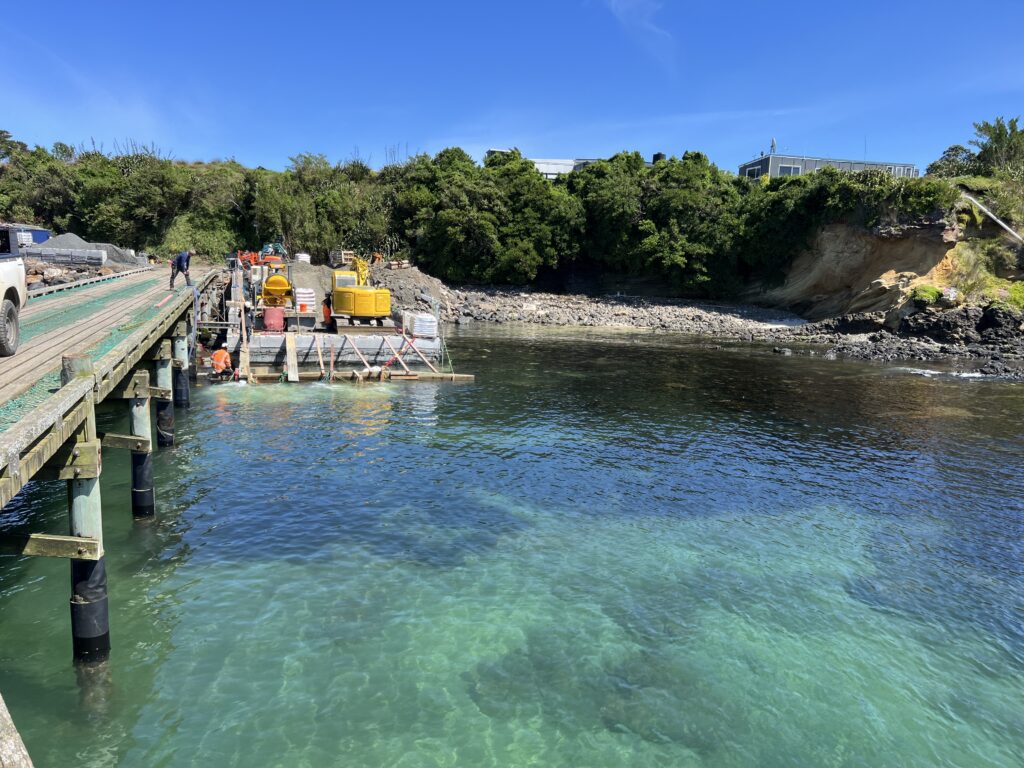
The Owenga ramp project on the Chatham Islands presented a unique set of engineering and logistical challenges. Located at one of New Zealand’s most remote inhabited outposts - some 800 kilometres east of the South Island - the site demanded a construction solution that could be delivered with minimal on-
site resources, withstand a harsh marine tidal environment, and be installed with precision under challenging tidal conditions.
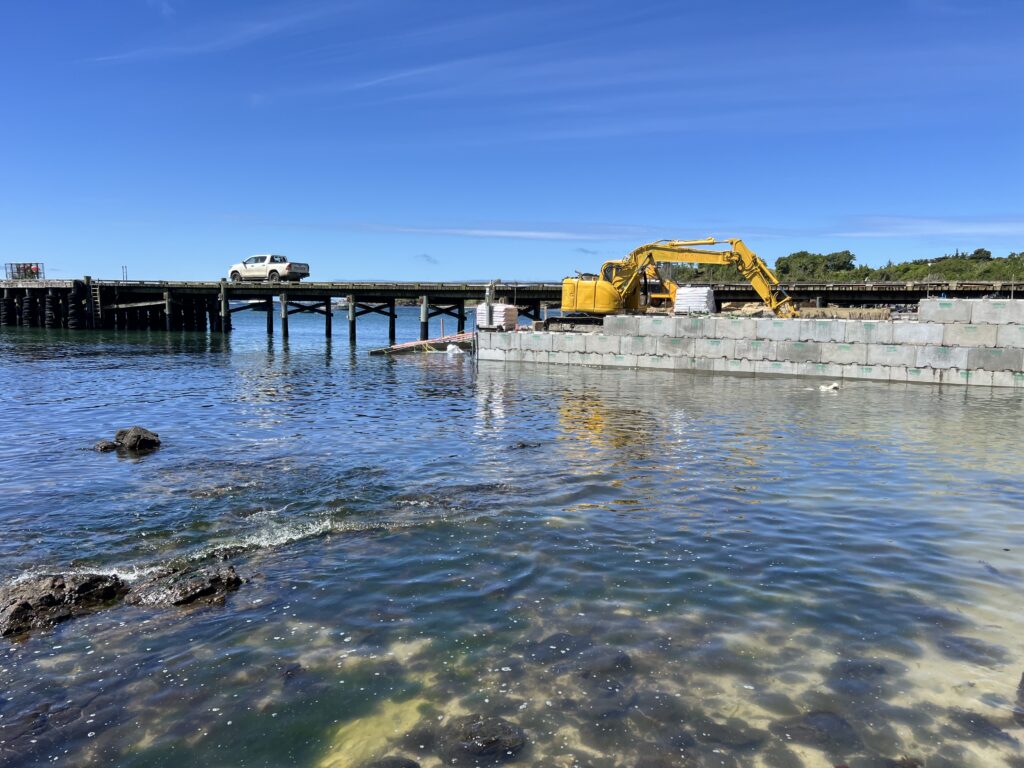
Hunter Civil Ltd, appointed as contractor and led on-site by Project Manager Jess Baker, selected Interbloc precast concrete blocks as the primary structural solution. The result was a successful ramp installation that demonstrated the adaptability of the Interbloc system in one of the most demanding environments imaginable.
THE CHALLENGE
The Chatham Islands presented a combination of constraints that ruled out conventional construction methods from the outset:
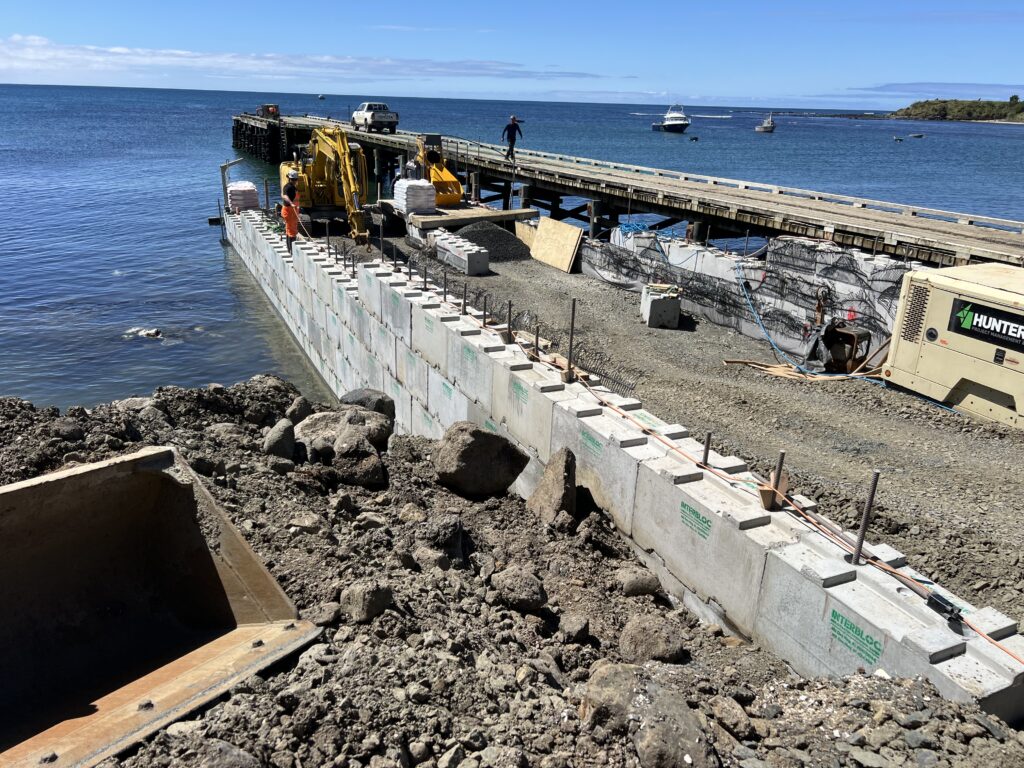
- No concrete plant on the island - all concrete would have required hand mixing on-site, making quality control for a structural marine application extremely difficult.
- No viable temporary formwork for in-situ concrete pours directly into the sea, which the original design had specified.
- Tidal working windows restricted available construction time, requiring the team to plan placement and drilling activities around tide schedules.
- Significant ocean currents at the site made precise block placement in the deeper sections of the ramp challenging.
- Remote supply chain logistics meant all materials had to be transported via Timaru and then by sea, passing through multiple handling stages.
Faced with these constraints, the project team worked closely with the designer to develop a revised construction methodology. The solution centred on the use of Interbloc® precast concrete blocks — a decision that addressed each of the site’s key limitations in a single step.
THE SOLUTION
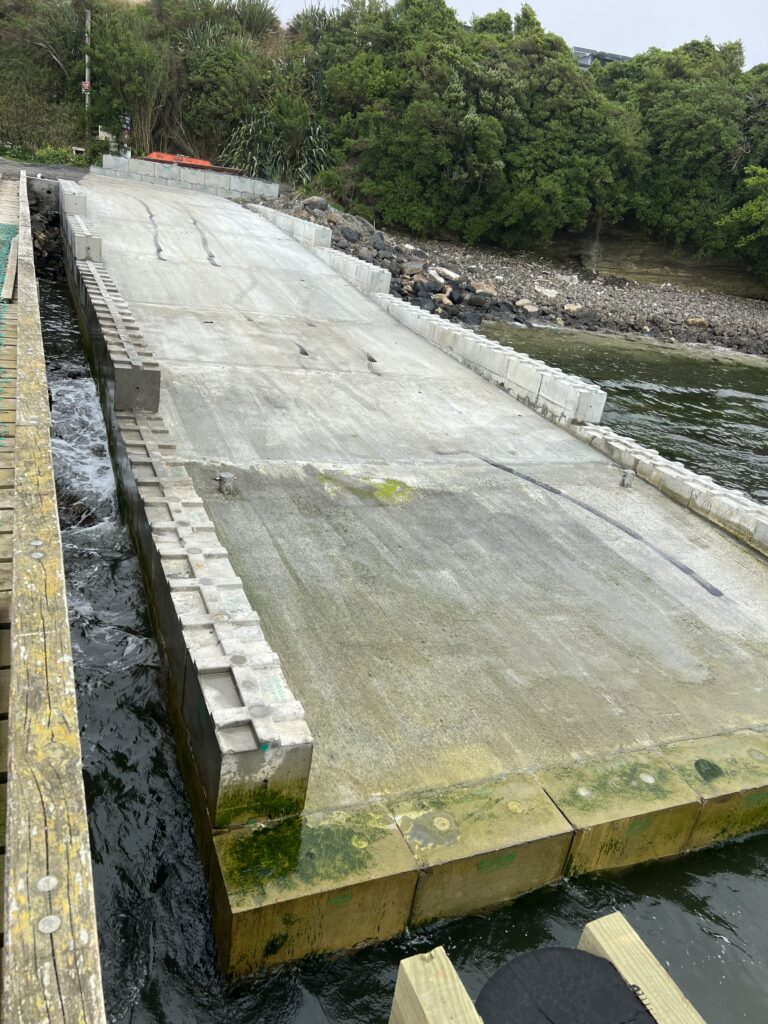
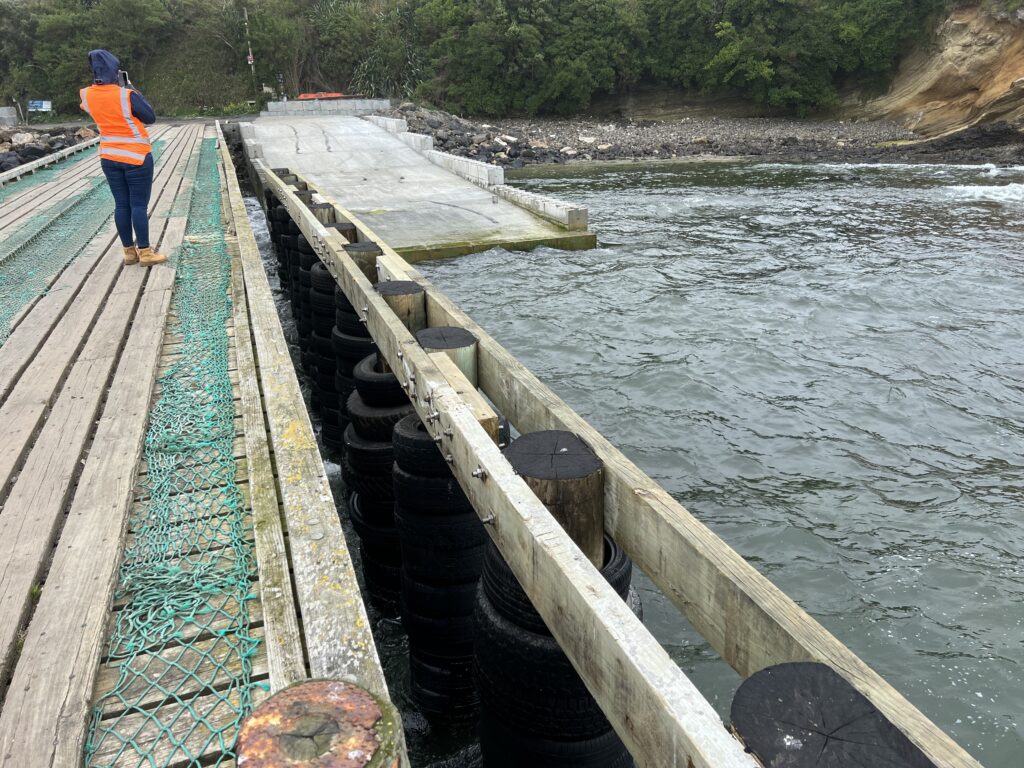
By switching from in-situ concrete to Interbloc precast units, the project immediately eliminated the quality risk associated with hand-mixed on-site concrete. Each block was cast in a controlled factory environment before being shipped to the island, ensuring structural consistency that would have been impossible to achieve through site mixing.
FACTORY-CONTROLLED QUALITY
ANCHOR INTEGRATION
A critical feature of the Interbloc system that proved invaluable on this project was the pre-formed hollow core running through each block. Once the blocks were positioned along the ramp alignment, the team drilled through these hollow inserts directly into the bedrock below, then grouted anchors into the rock. This locked the entire ramp structure firmly to the seabed, providing the structural resistance needed in a dynamic tidal and wave environment. Without the pre-formed void, the team would have faced the time-consuming and costly task of drilling through the full depth of solid concrete block before reaching the rock. The Interbloc® design effectively removed this barrier entirely.
TIDAL SCHEDULING
The Hunter Civil team strategically timed the installation to coincide with spring tides, maximising the duration of low-tide working windows. The crew worked flexible hours around the tidal schedule to make the most of each available access period. In the deeper sections of the ramp where ocean currents were strongest, a minor design adaptation - slightly shortening the ramp - allowed the project to proceed safely without compromising structural intent.
GROUTING IN WET CONDITIONS
Drilling and grouting in a tidal zone inevitably means working with wet anchor holes. The team managed this effectively by blowing out excess water from the drilled holes before grouting, then trimming the grout in from the bottom so that residual water was displaced upward and out as the grout filled the void. This technique ensured full bond without the need for costly dewatering operations.
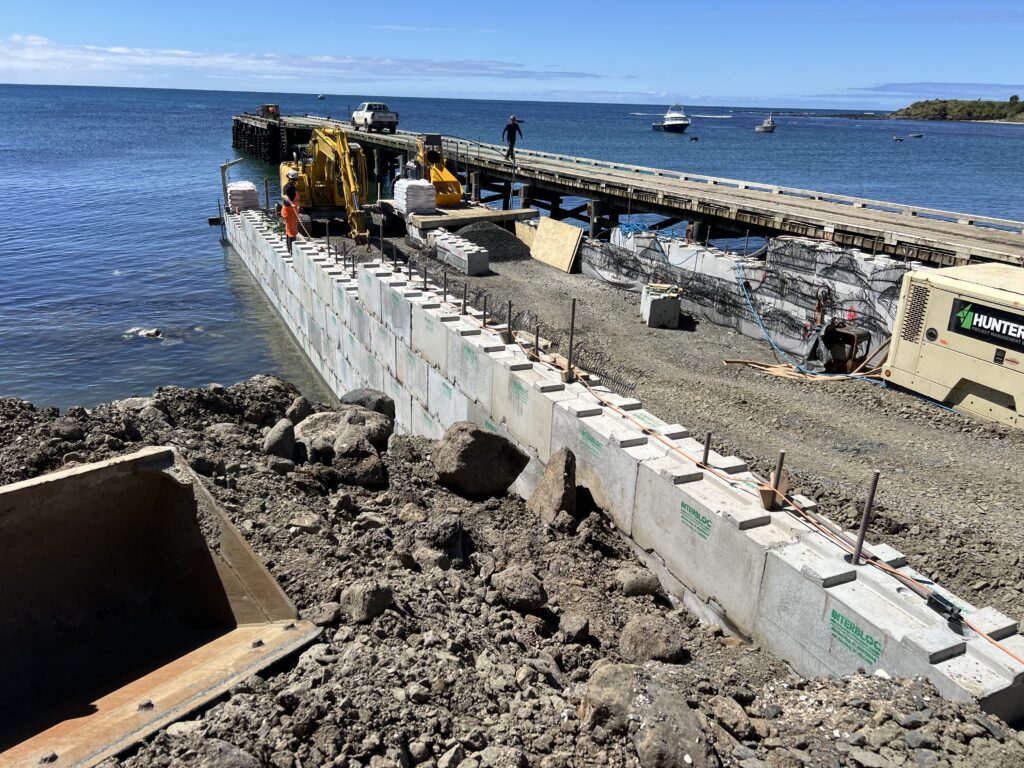
SUPPLY CHAIN & LOGISTICS
Getting the Interbloc units to the Chatham Islands was itself a logistical achievement. Blocks were dispatched from the mainland via Timaru, then transported by sea to the island - passing through multiple handling stages along the way. The inherent durability of the precast concrete product meant the blocks arrived on-site in full working condition despite the extended and physically demanding supply chain.
OUTCOME
The Owenga ramp was completed successfully in 2024. The finished structure provides a durable, rock-anchored ramp suitable for use in a challenging marine tidal environment. The project stands as a strong example of how the Interbloc system can be adapted to meet the demands of remote, resource-constrained infrastructure projects where conventional construction methods are simply not viable.
“Once you got the system going, the blocks locked together and were relatively easy to work with. The pre-formed holes in the blocks were essential - without them we would have been drilling through the full block as well as the rock, which would have added significant time to the job.”
Jess Baker, Project Manager — Hunter Civil Ltd
KEY BENEFITS DEMONSTRATED
- Factory-quality concrete: Eliminated on-site quality risk where no batching plant existed.
- Pre-formed anchor voids: Enabled through-block drilling and rock grouting without drilling through solid concrete.
- Rapid installation: Interlocking system allowed efficient block placement with minimal plant.
- Structural versatility: Blocks used to form a bunded ramp structure, backfilled in sections with geogrid for mass retention.
- Supply chain resilience: Heavy precast units withstood multi-stage handling from mainland to remote island destination.
- Tidal zone performance: Effective grouting method developed for wet anchor holes without dewatering.
ABOUT INTERBLOC
Interbloc® is a New Zealand-manufactured precast concrete block system designed for retaining walls, bunds, ramps, and heavy-duty civil applications. The Interbloc system combines ease of installation with engineering-grade structural performance, making it the preferred choice for projects where speed, quality, and adaptability are critical. Available as a standard off-the-shelf product or custom-manufactured to project specifications - including geogrid integration and specialty concrete mixes - Interbloc is at work on infrastructure projects across New Zealand and the Pacific.
For more information visit interbloc.co.nz
Canterbury owner-builder Jono Wilson chooses Stonebloc for privacy, noise abatement, and a look that suits the house that's been in his family for generations.
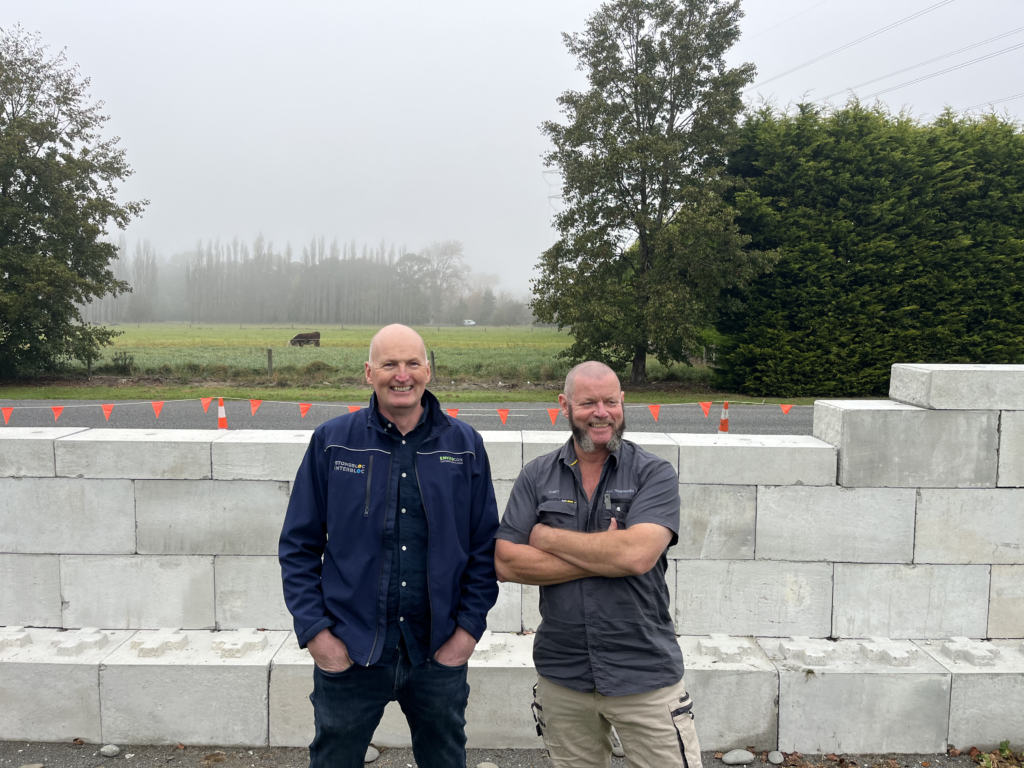
Jono Wilson knows this property better than anyone. He was born on it. He bought it from his parents, finished building the house just before the 2011 Christchurch earthquakes, and has been quietly working on it with his wife ever since.
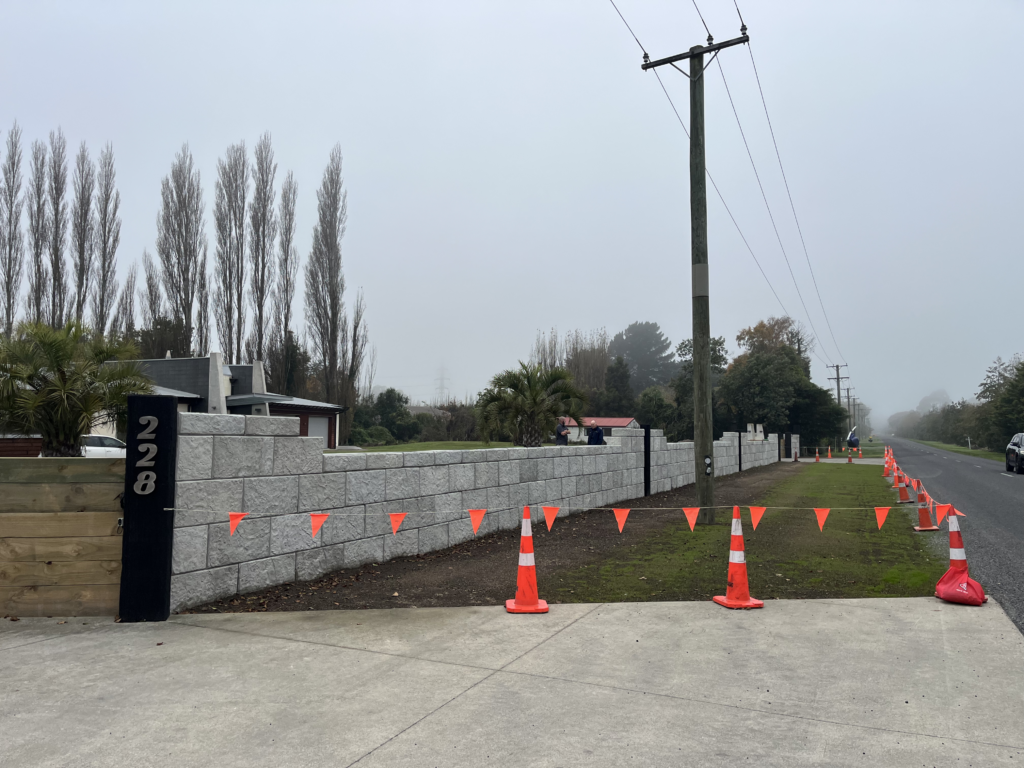
That last major thing is a 605-block, 193-tonne Stonebloc gravity retaining wall — designed, redesigned, and installed by Jono and his wife themselves.
A HEDGE, A MOUND, AND A BETTER IDEA
The project started with a hedge that had to come out. Jono needed to replace the privacy and noise abatement it had given the property, but he didn’t want to throw up a bigger mound to do it.
“Instead of building a bigger mound, we decided to cut the existing mound in half and take it out to the boundary,” he explains. “The product we found from Envirocon seemed ideal for that, being a gravity retaining wall.”
He looked at several systems before landing on Stonebloc. The decisive factors were aesthetic and practical.
“We liked it, the size of it was sympathetic with the honed stone block we had on the house, and clearly we like concrete. My wife and I installed it ourselves because we’ve got the equipment to lift and move it around — that was part of the enjoyment of doing something yourself.”
DESIGNING IN ENVIROBUILD
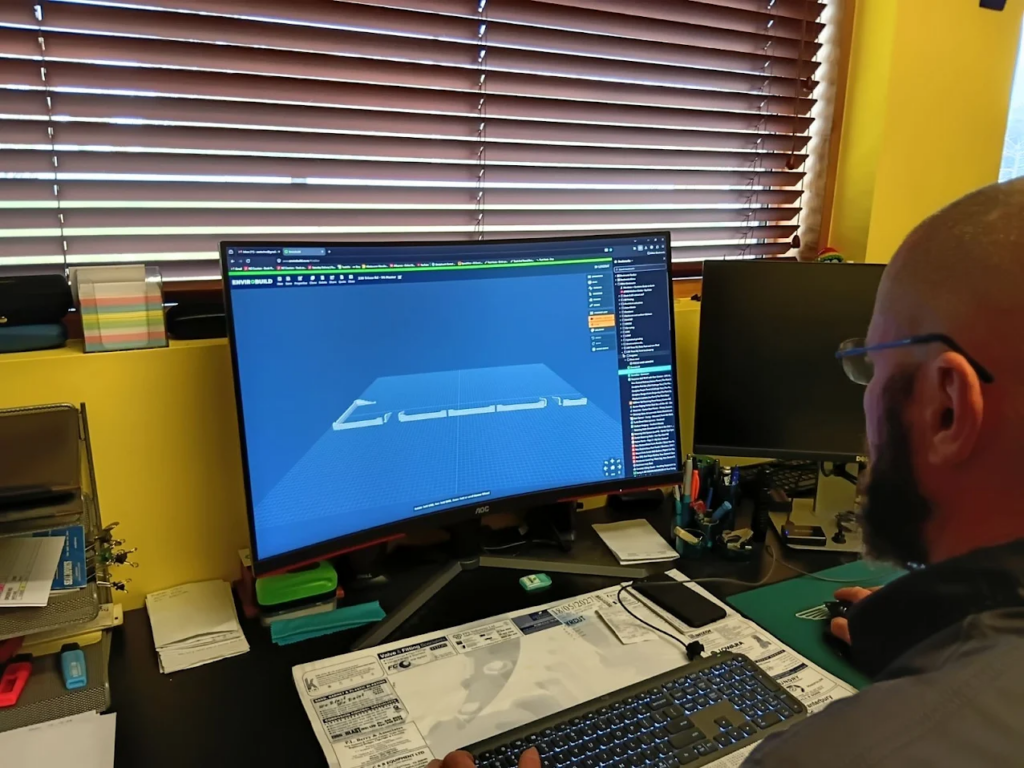
The wall didn’t arrive at its final form in a single sitting. Jono used Envirocon’s Envirobuild 3D design software to iterate — testing layouts, swapping block sizes, and refining the look until it sat right against the house.
“Originally, I started out with quite a simple wall,” he says. “But sitting with the software, I thought, ‘I wonder what it’d look like if I did this.’ It evolved as we went along.”
The final design uses Ironbark posts between sections to break up the wall, hide existing concrete buttresses from a build fifteen years earlier, and create a deliberate negative detail. “We end up making it look like we knew what we were doing right from the start.”
HEAVY RESIDENTIAL, LIGHT CIVIL
For Jono, Stonebloc sat in exactly the right product category. He considered Interbloc first, but the one-tonne blocks were beyond what his skid steer could safely lift.
“Stonebloc® is a much better product for the aesthetic we wanted. Interbloc® — the keys go right through them, so they look a bit more industrial. Stonebloc® came down low enough into that realm of heavy residential, light civil, that we could handle ourselves.”
The Croatia texture was the right finish for the site. Sleek, smooth, and modern, it complemented the existing house without tipping into industrial territory.
LIKE BIG LEGO
Once the foundation was right, the rest of the build became — in Jono’s words — straightforward.
“Once you get those base blocks down in the right orientation, the rest of it is just build it up. It’s literally like playing with big Lego.”
That modularity also gave Jono something most retaining systems don’t: the ability to undo a mistake. When the first wall section looked wrong against the road’s grade, he and his wife pulled the whole thing apart, had the foundation re-cut, and rebuilt it.
“That was really good — you can pull things apart and put them back together. If they were grouted or bolted, you couldn’t. We just pulled things off, did the work, and put it all back.”
A WALL FOR THE LONG VIEW
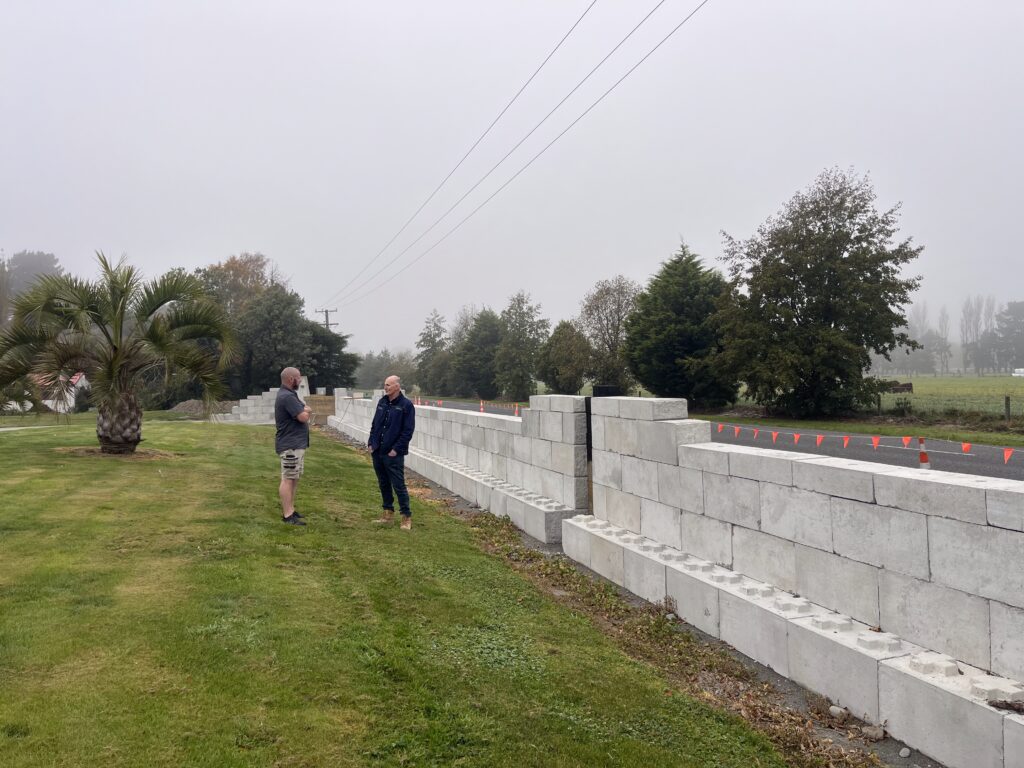
Across roughly 660 blocks, 21 truckloads, and 190 tonnes of concrete, Stonebloc has given Jono a wall that fits the property, suits the house, and will outlast him. Native plantings will sit on a plateau of backfill behind the wall, growing up to restore the privacy lost with the hedge.
“The concrete reflects sound a lot better than the hedge ever did. When the trucks go past now, you can hear the difference — louder, softer, louder, softer — as they pass the gateway.”
The Wilson project still has a season or two of backfilling, planting, and finishing ahead of it. But the core build — the part Stonebloc was chosen for — is almost done.
“This is the last major thing to do,” Jono says.
Recently at Nelson Port, Interbloc units were subjected to a significant real-world impact after being struck by heavy machinery, involving an excavator weighing approximately 30 tonnes.
Despite the force of the collision, the Interbloc blocks remained standing, clearly demonstrating the inherent strength, stability, and resilience of the system.
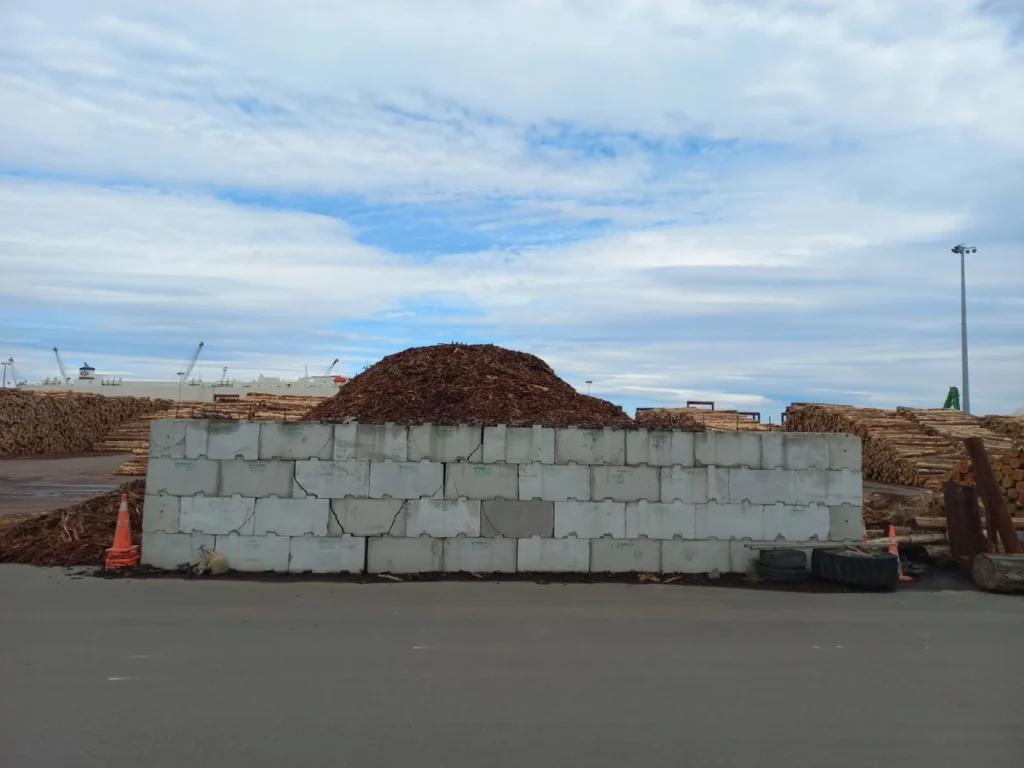
This incident highlights the safety and performance benefits of reinforced Interbloc systems, which are engineered not only to retain ground but also to protect people, assets, and operational continuity in high-risk environments such as ports, industrial sites, and transport hubs.
Real-world events like this provide powerful validation of why properly engineered, reinforced infrastructure solutions matter. In locations subject to heavy plant movement and constrained operating conditions, the consequences of failure can be severe. In this instance, the robustness of the Interbloc system helped mitigate what could have been a far more serious outcome.
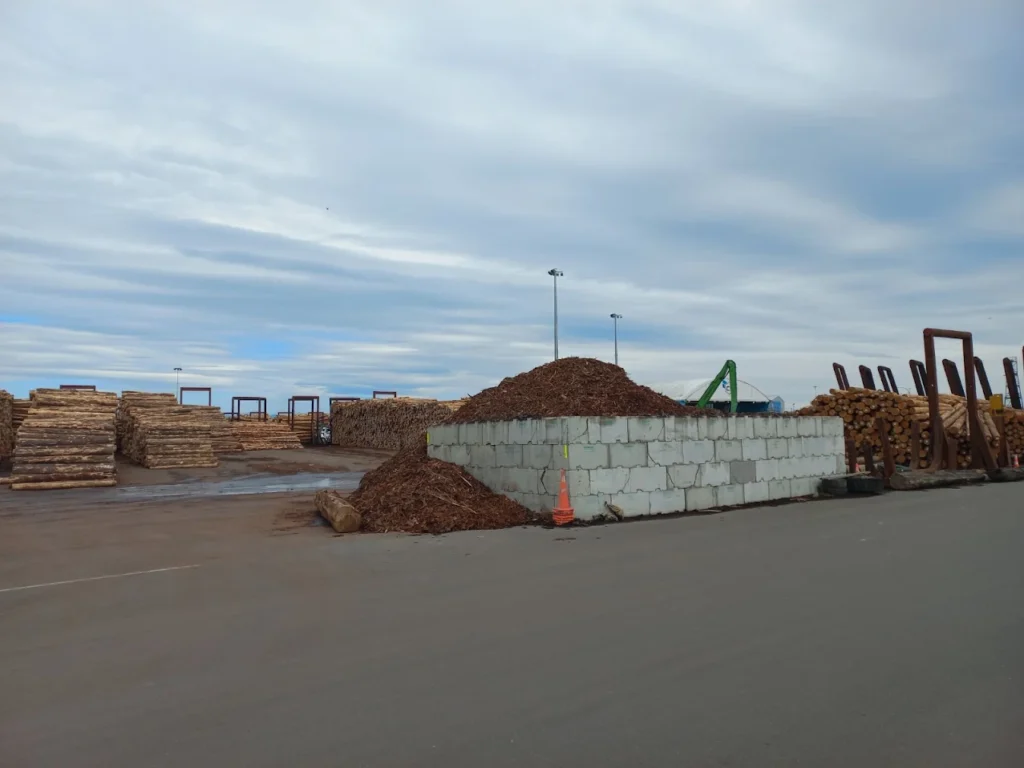
At Envirocon, we are proud to supply and support Interbloc solutions that perform when it matters most, delivering confidence, safety, and resilience in demanding applications.
A major storm event on the West Coast recently caused widespread disruption, cutting all road access into and out of the region. Several critical routes were closed due to significant slips and underslips, including State Highway 6 near Coal Creek, south of Murchison, leaving communities and freight operators isolated.
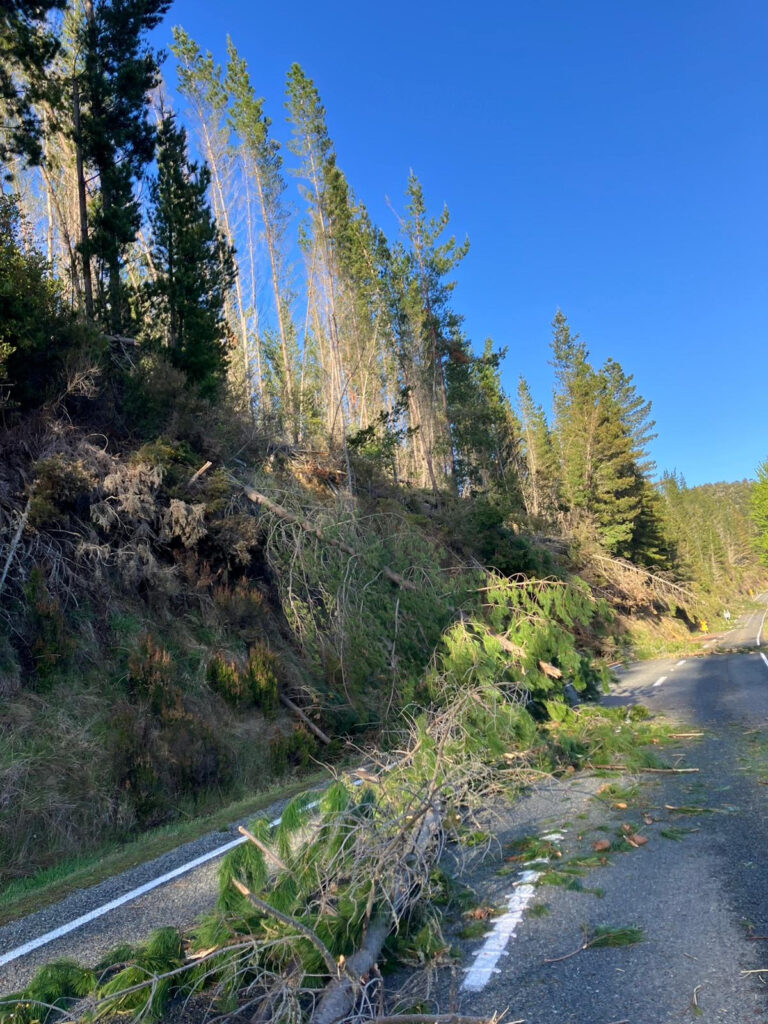
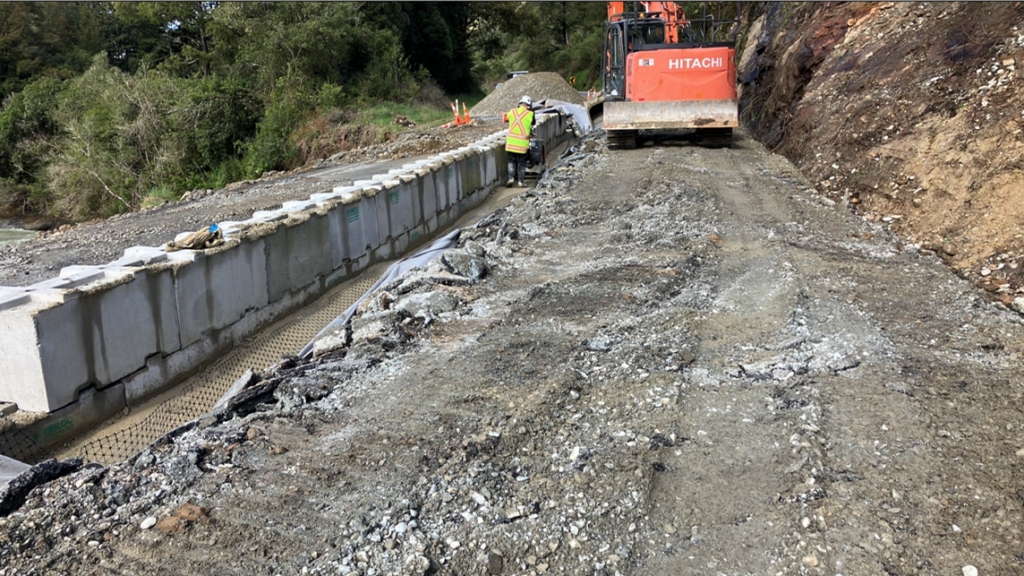
At this location, the rapid reopening of SH6 was critical to restoring connectivity for local communities and maintaining essential freight movements. The speed and effectiveness of the emergency response were made possible through the use of Interbloc precast concrete blocks, which enabled the fast construction of a temporary single-lane carriageway capable of carrying heavy vehicles.
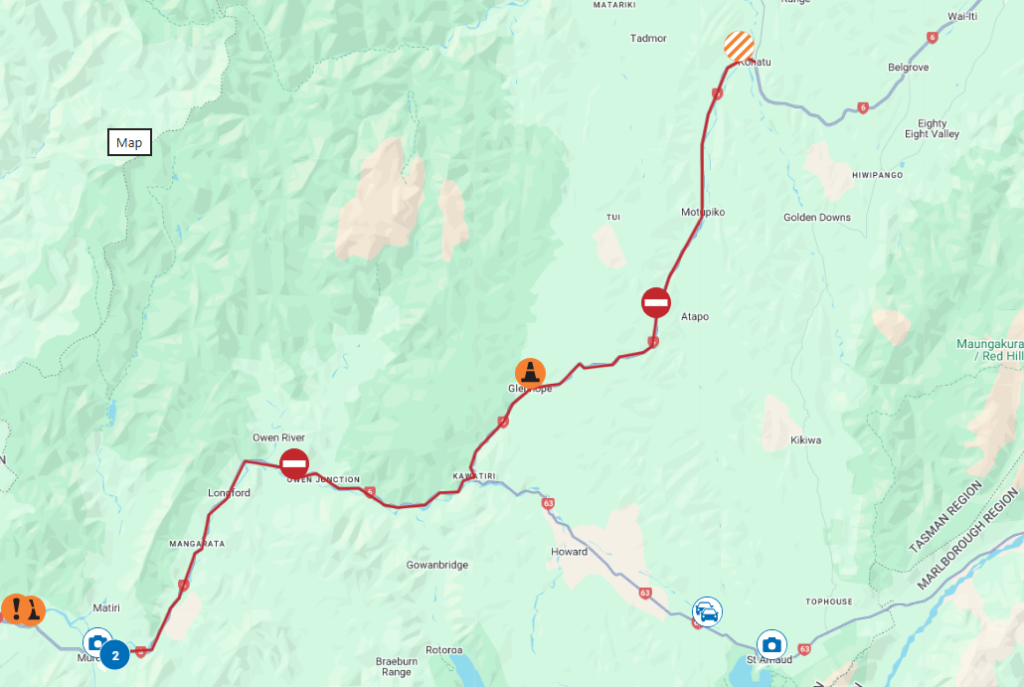
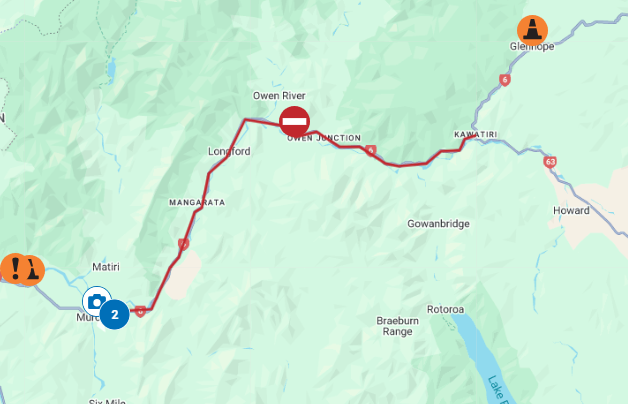
One of the key advantages of the Interbloc solution was local availability. Interbloc units were already stockpiled at Fulton Hogan’s Appleby Quarry, allowing construction crews to mobilise immediately. This eliminated the significant delays that would have occurred if materials had needed to be transported from Christchurch via Blenheim, enabling repair works to begin without delay and the highway to reopen sooner.
This project demonstrates how modular, reusable infrastructure systems such as Interbloc can play a vital role in emergency response and network resilience, particularly when supported by strategic local stockpiling. The ability to deploy a proven, heavy-duty solution at short notice was instrumental in reducing downtime on a critical transport corridor.
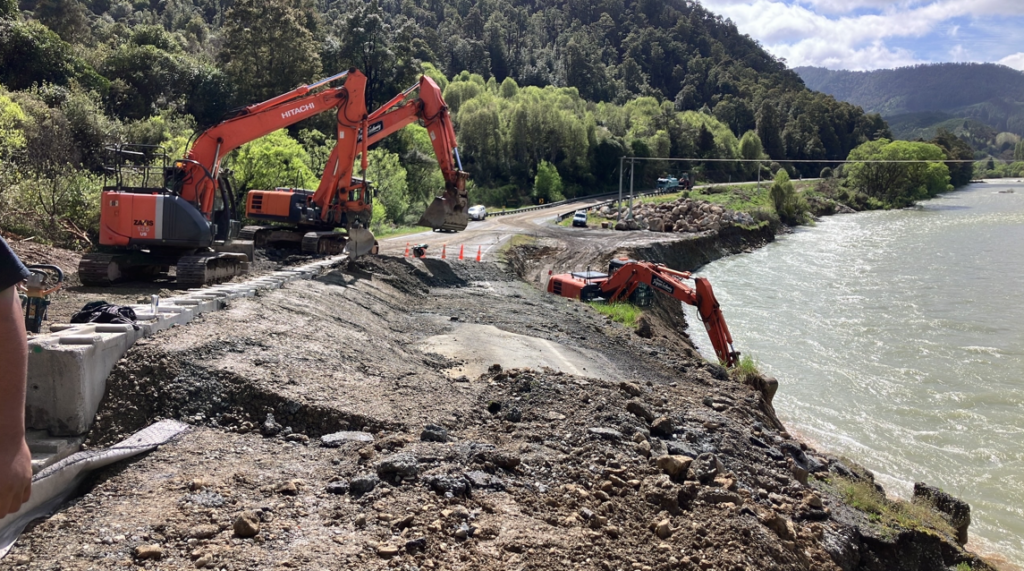
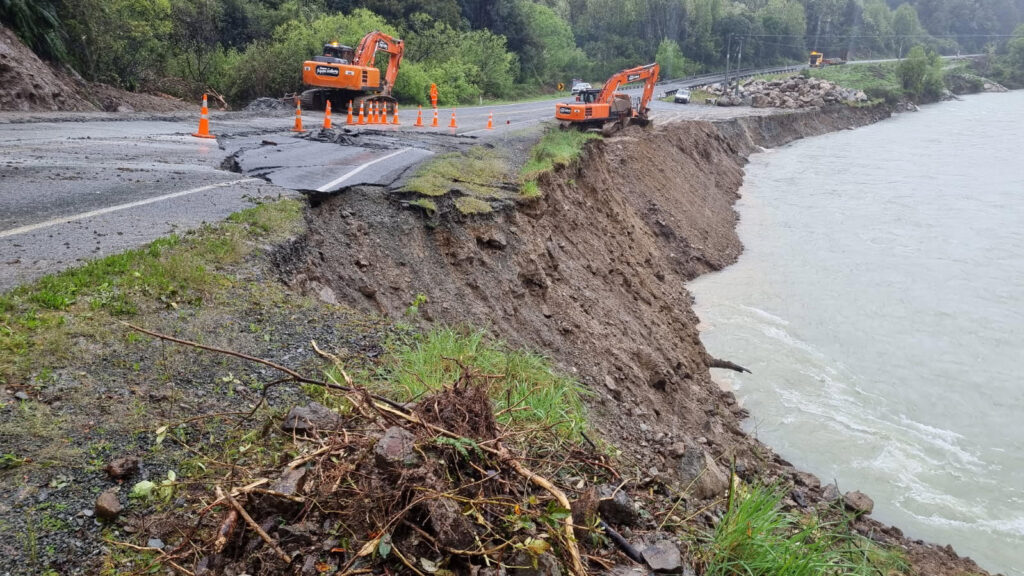
Credit goes to Fulton Hogan and all crews involved for their efficient, safe, and highly effective work under challenging conditions.
The newly installed Croatia-texture Interbloc+ retaining wall at Northcote College is a standout example of how modern precast systems can deliver both structural performance and architectural quality. Installed only a few months ago, the wall is already demonstrating the durability, stability, and visual refinement expected from the Interbloc+ product range.
Positioned alongside one of the school’s main buildings, the retaining structure supports significant elevation changes while presenting a clean, cohesive appearance that enhances the overall site. The Croatia texture — inspired by natural stone — adds depth and character, helping the wall blend seamlessly with both the landscaped terraces and the contemporary architecture of the college.
Engineering Performance with an Architectural Edge
The Northcote College project highlights the versatility of Interbloc+ in delivering two key outcomes:
- Robust structural performance suitable for high-use public environments
- A visually appealing, architectural finish that elevates the surrounding space
The interlocking design of Interbloc+ enables rapid installation and reliable long-term behaviour, making it ideal for environments where safety and durability are paramount.
Designed for Schools and Public Facilities
Schools require infrastructure that is safe, resilient, and low-maintenance. Interbloc+ systems meet these demands through:
- Engineered stability backed by proven load-bearing performance
- Fast, efficient installation with minimal disruption
- Precast concrete durability suited for long-term public use
- A refined, cohesive aesthetic supporting modern campus design
At Northcote College, the retaining wall is performing exactly as intended — supporting pedestrian circulation, tiered outdoor areas, and seating zones while maintaining an architectural finish that enhances the everyday environment for students and staff.
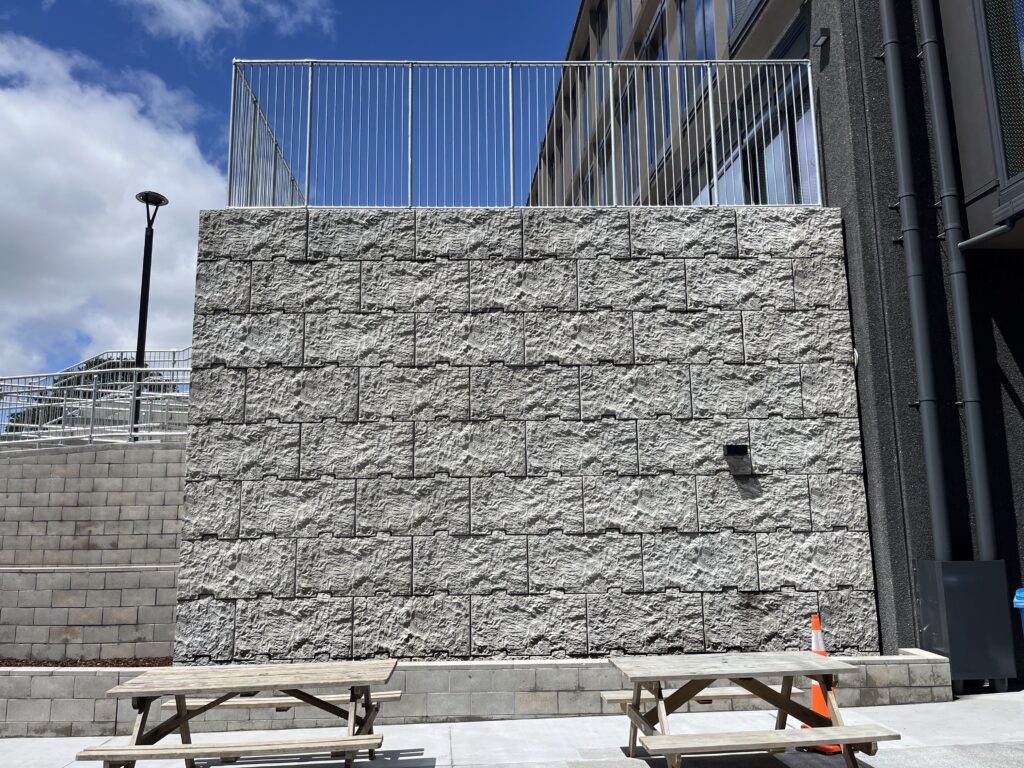
A Strong Example of Interbloc+ in Action
This installation demonstrates how the Interbloc+ Croatia texture can transform a functional retaining structure into an architectural feature. The result is a safe, durable, and visually cohesive space that reflects the standards increasingly expected in modern educational and public facilities.
Interbloc+ continues to prove that high-performance engineering and high-quality design can — and should — go hand in hand.